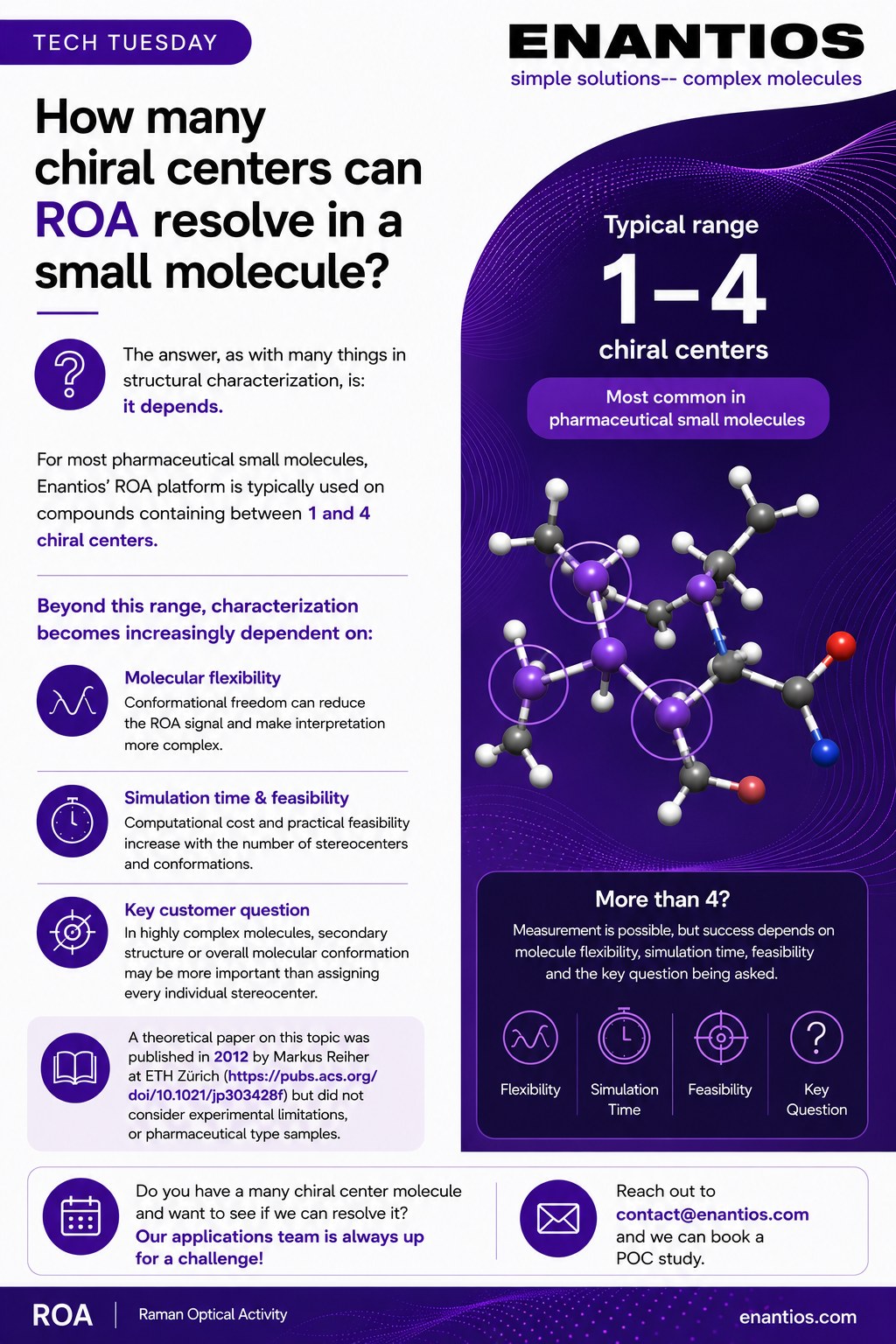
The answer, as with many things in structural characterization, is: it depends.
For most pharmaceutical small molecules, the Enantios ROA platform is typically used on compounds containing between 1 and 4 chiral centers — the most common range in pharmaceutical small molecules.
Beyond this range, characterization becomes increasingly dependent on:
- Molecular flexibility – conformational freedom can reduce the ROA signal and make interpretation more complex.
- Simulation time & feasibility – computational cost and practical feasibility increase with the number of stereocenters and conformations.
- The key customer question – in highly complex molecules, secondary structure or overall molecular conformation may be more important than assigning every individual stereocenter.
More than 4? Measurement is possible — success depends on the molecule’s flexibility, simulation time, feasibility, and the key question being asked.
📖 A theoretical paper on this topic was published in 2012 by Markus Reiher at ETH Zürich (doi.org/10.1021/jp303428f), but it did not consider experimental limitations or pharmaceutical-type samples.
Do you have a molecule with many chiral centers and want to see if we can resolve it? Our applications team is always up for a challenge! Reach out to contact@enantios.com and we can book a POC study.