Literature Highlight
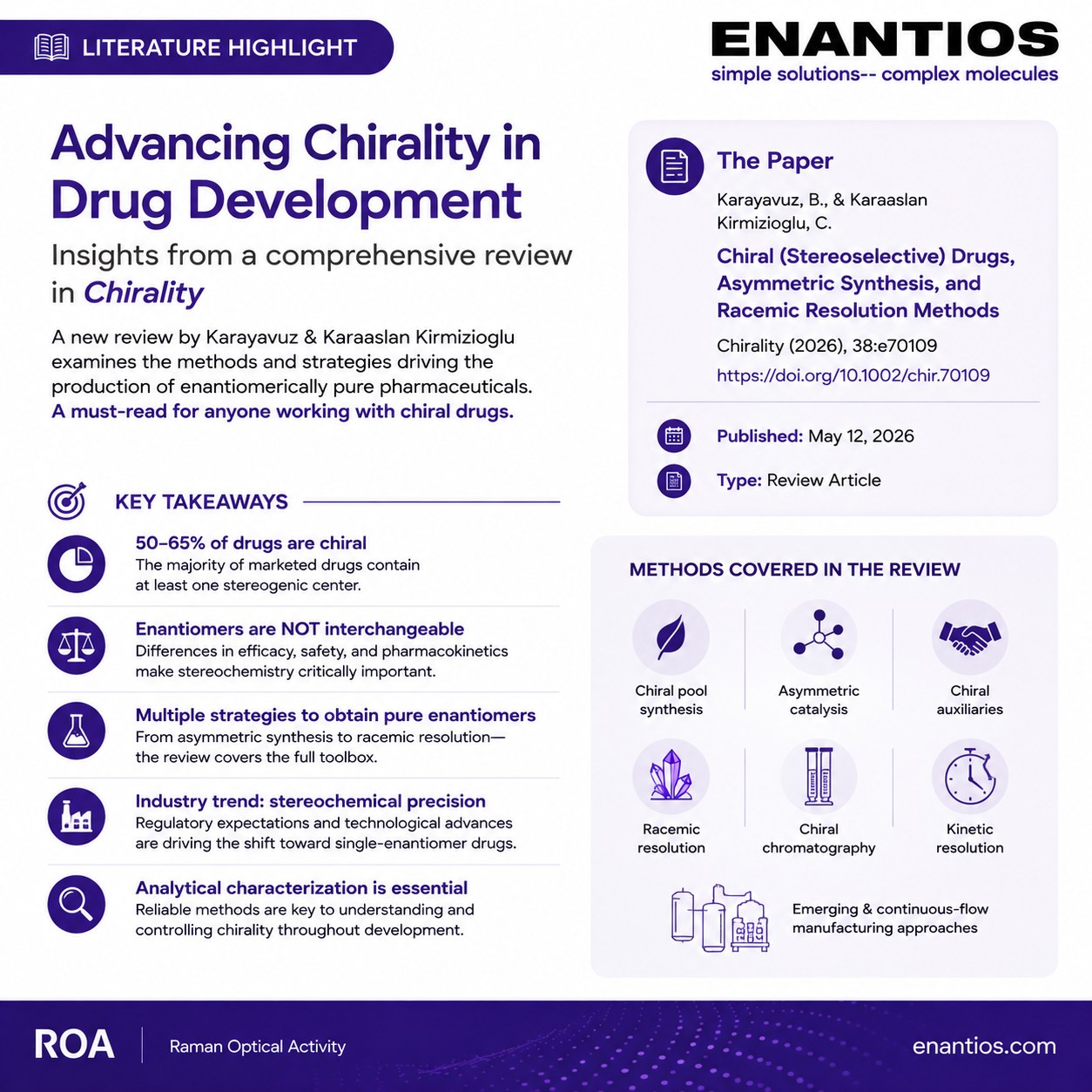
A new review by Karayavuz & Karaaslan Kirmizioglu, published in Chirality, examines the methods and strategies driving the production of enantiomerically pure pharmaceuticals. A must-read for anyone working with chiral drugs.
📄 The paper: Karayavuz, B., & Karaaslan Kirmizioglu, C. Chiral (Stereoselective) Drugs, Asymmetric Synthesis, and Racemic Resolution Methods. Chirality (2026), 38:e70109. Published May 12, 2026 (review article). https://doi.org/10.1002/chir.70109
Key takeaways
- 50–65% of drugs are chiral – the majority of marketed drugs contain at least one stereogenic center.
- Enantiomers are NOT interchangeable – differences in efficacy, safety, and pharmacokinetics make stereochemistry critically important.
- Multiple strategies to obtain pure enantiomers – from asymmetric synthesis to racemic resolution, the review covers the full toolbox.
- Industry trend: stereochemical precision – regulatory expectations and technological advances are driving the shift toward single-enantiomer drugs.
- Analytical characterization is essential – reliable methods are key to understanding and controlling chirality throughout development.
Methods covered in the review include chiral pool synthesis, asymmetric catalysis, chiral auxiliaries, racemic resolution, chiral chromatography, kinetic resolution, and emerging and continuous-flow manufacturing approaches.