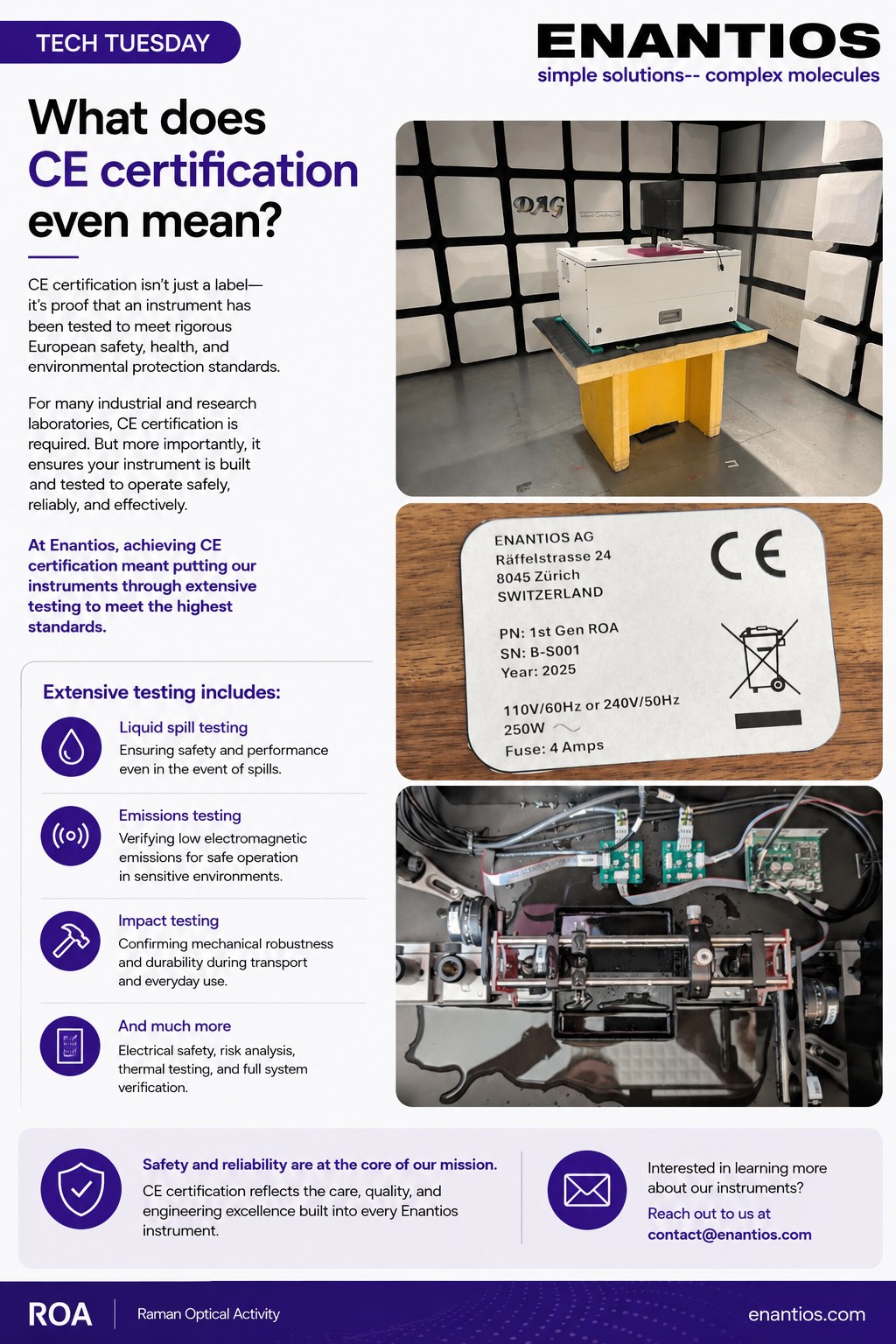
CE certification isn’t just a label — it’s proof that an instrument has been tested to meet rigorous European safety, health, and environmental protection standards.
For many industrial and research laboratories, CE certification is required. But more importantly, it ensures your instrument is built and tested to operate safely, reliably, and effectively.
At Enantios, achieving CE certification meant putting our instruments through extensive testing to meet the highest standards, including:
- 💧 Liquid spill testing – ensuring safety and performance even in the event of spills.
- 📡 Emissions testing – verifying low electromagnetic emissions for safe operation in sensitive environments.
- 🔨 Impact testing – confirming mechanical robustness and durability during transport and everyday use.
- ⚙️ And much more – electrical safety, risk analysis, thermal testing, and full system verification.
Safety and reliability are at the core of our mission. CE certification reflects the care, quality, and engineering excellence built into every Enantios instrument.
Interested in learning more about our instruments? Reach out to us at contact@enantios.com.