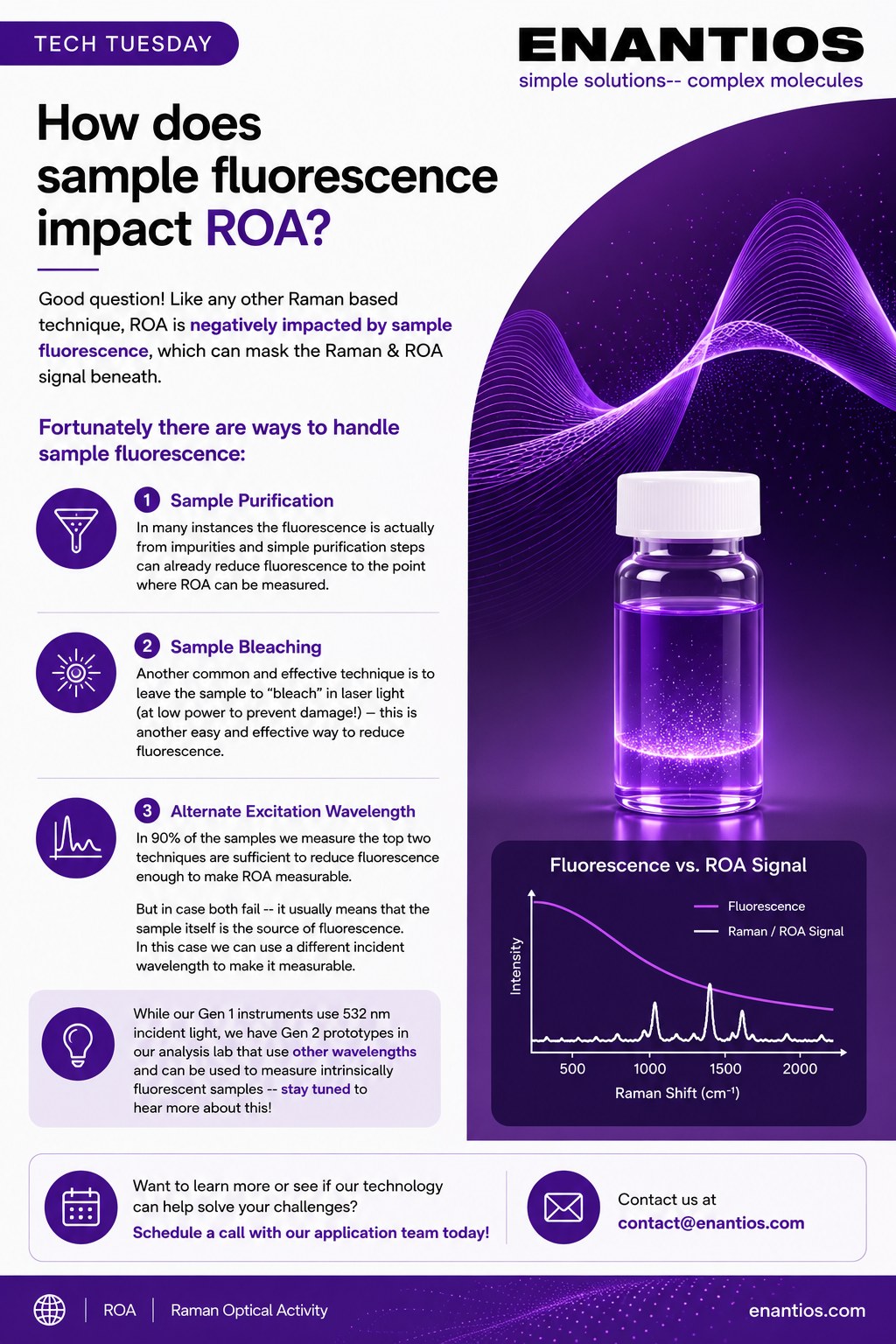
Good question! Like any other Raman-based technique, ROA is negatively impacted by sample fluorescence, which can mask the Raman and ROA signal beneath it.
Fortunately, there are ways to handle it:
1. Sample purification
In many instances the fluorescence actually comes from impurities, and simple purification steps can already reduce it to the point where ROA can be measured.
2. Sample bleaching
Another common and effective technique is to leave the sample to “bleach” in laser light — at low power, to prevent damage! This is another easy way to reduce fluorescence.
3. Alternate excitation wavelength
In 90% of the samples we measure, the first two techniques are enough to make ROA measurable. If both fail, it usually means the sample itself is the source of the fluorescence — and in that case we can use a different incident wavelength.
💡 While our Gen 1 instruments use 532 nm incident light, we have Gen 2 prototypes in our analysis lab that use other wavelengths and can be used to measure intrinsically fluorescent samples. Stay tuned to hear more about this!
Want to learn more, or see if our technology can help solve your challenges? Schedule a call with our applications team at contact@enantios.com.